
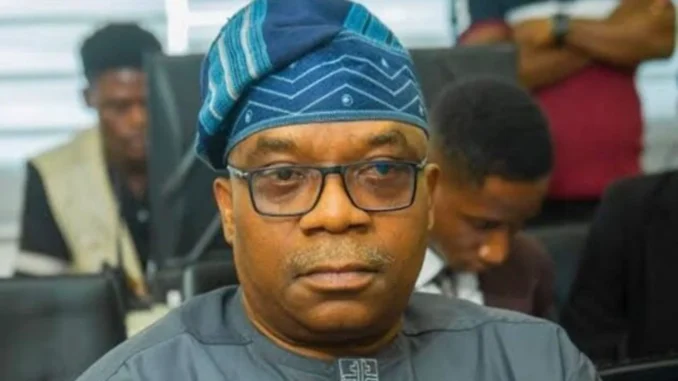
Minister of State for Foreign Affairs, Ambassador Sola Enikanolaiye, has declared that Nigeria’s quest to regain its traditional leadership role in Africa and strengthen its global influence depends fundamentally on resolving domestic economic, security and governance challenges .
Speaking in Abuja on Thursday during the launch of “Shadows of Power,” a book authored by retired Rear Admiral Sola Oluwagbire, the minister argued that a strong and effective foreign policy can only be built on a foundation of national stability and unity .
“You cannot have a dynamic and activist foreign policy if the home is weak, if the country is disunited, if there is no harmony in Nigeria. How can you go outside and be taken seriously?”
Enikanolaiye explained that although Nigeria remains committed to its longstanding role in African affairs, domestic security and prosperity must take precedence before the country can effectively project influence beyond its borders .
The ‘Nigeria First’ Doctrine: A New Foreign Policy Framework
The minister disclosed that the Federal Government has adopted a foreign policy framework anchored on national interest, with the welfare of Nigerians serving as its central focus .
“The motto of the Ministry of Foreign Affairs is actually ‘Nigeria First’. Every foreign policy action we take must speak to Nigeria,” Enikanolaiye stated .
He explained that the current administration has restructured its diplomatic priorities to ensure that issues relating to national security, economic growth and citizens’ welfare remain at the forefront of engagement with other countries .
“We are locating Nigeria and Nigerians at the core of foreign policy preoccupations so that our national interest that advances our security, our defence and our economic prosperity are the core of Nigerian foreign policy,” he said .
This approach represents a significant shift from previous diplomatic practices, emphasising tangible benefits for Nigerian citizens rather than abstract diplomatic posturing . The 4D Foreign Policy Doctrine—Demography, Development, Democracy and Diaspora—now guides Nigeria’s international engagements .
Domestic Stability as Prerequisite for Global Influence
Enikanolaiye stressed that sustainable international relevance cannot be separated from domestic stability, economic strength and national security .
“We believe that these objectives are mutually reinforcing. Nigeria has to be secure, we have to be stable before we can even play that activist role in foreign policy that traditionally we regarded as having played in the liberation struggle and other continental engagements,” he said .
The minister’s remarks come amid growing concerns about Nigeria’s diminishing international influence. Despite the country’s historical leadership in peacekeeping operations, regional integration efforts and anti-colonial struggles, economic pressures and persistent security challenges have fuelled doubts about its continued relevance .
However, Enikanolaiye expressed optimism about Nigeria’s trajectory:
“Nigeria is still very much on course. Our visibility may have dimmed a little, but we’re trying to bring that back,” he said .
The ongoing reforms being implemented by President Bola Tinubu are designed to strengthen Nigeria internally and position the country for greater diplomatic relevance internationally .Regional Focus: Prioritising Nigeria’s Neighbourhood
The minister identified Nigeria’s immediate neighbourhood as a key strategic priority, stressing that events in neighbouring countries directly affect the nation’s stability and development .
“Our neighbours, our security, prosperity and development are intrinsically linked to those of our neighbours. If they are not secure, it has implications for us,” Enikanolaiye said .
He clarified that the renewed focus on Nigeria’s immediate region does not amount to a departure from Africa-centred diplomacy but rather a recalibration of priorities .
“We have decided to reprioritise that region before we move further to Africa without necessarily jettisoning Africa as the cornerstone of our foreign policy,” he explained .
This regional prioritisation is informed by the interconnected nature of security threats across West Africa. The minister highlighted challenges confronting the region, including terrorism, unconstitutional changes of government, proliferation of small arms and light weapons, drug and human trafficking, banditry, and transnational crimes .
The withdrawal of some member states from the Economic Community of West African States (ECOWAS) and the growing influence of external powers in the region also require careful diplomatic management .
Strategic Autonomy: Balancing Global Partnerships
On relations with major world powers, Enikanolaiye said Nigeria would continue to pursue a policy of strategic independence, ensuring that all international partnerships are guided by national interests rather than ideological considerations .
“What is strategic autonomy? Simply put, it means alignment to our national interest. Therefore, wherever the wind blows, that’s where we go in pursuit of Nigeria’s interest,” he said .
He added that Nigeria remains open to cooperation with a wide range of global partners, including countries in both the Western and Eastern blocs .
“We may have tilted a little to the West, but we have not abandoned our traditional partners. All of them remain important partners in Nigerian foreign policy,” he stated .
The minister also defended the government’s renewed engagement with the United States and other Western nations on security matters, describing the move as an evolution of existing partnerships rather than a shift in policy direction .
“What has happened is a reinvigoration of those partnerships in a manner that addresses our current domestic security challenges,” he said .
Institutional Reforms: Strengthening Nigeria’s Diplomatic Service
Enikanolaiye revealed that reforms are ongoing within the Ministry of Foreign Affairs to improve efficiency, professionalism and institutional capacity .
“We are trying to rebuild the institution in terms of capacity building, systems and processes in a manner that instils confidence, morale and professionalism into the Ministry of Foreign Affairs,” he said .
The reforms include enhanced record management systems, predictable diplomatic postings, and compulsory training and examinations as prerequisites for career advancement .
“Every officer must undertake prescribed training, write an exam, and pass before they can be presented for promotion,” the minister disclosed .
He stressed that the reforms are designed to align diplomatic service standards with the discipline and professionalism found in the military .
The minister further advocated stronger collaboration between the country’s diplomatic and defence establishments, describing both as critical pillars of national development and security .
“Foreign policy is very critical. It is the flip side of defence policy, and both of them must be pursued in a coordinated manner so that our country can be better secured, prosperous and have a better future,” he added .
The 2026 Reform Agenda: Economic Resilience and National Development
The minister’s call for domestic strengthening aligns with broader government reform efforts. President Tinubu recently unveiled the Renewed Hope National Development Plan (2026–2030), a five-year blueprint aimed at moving Nigeria from economic recovery to total transformation .
The plan focuses on five key pillars:
- Economic Diversification: Reducing the nation’s over-reliance on oil
- Human Capital Development: Investing in health and education
- Subnational Competitiveness: Empowering states to leverage their comparative advantages
- Private Sector-Led Growth: Creating a business-friendly environment
- Climate Resilience: Building infrastructure capable of withstanding environmental shifts
President Tinubu emphasised that economic prosperity cannot exist without stability, declaring a decisive war on insecurity plaguing the nation .
“I promise you here that I’ll play my part. We will win with determination and resilience. We will overcome this unacceptable terrorism and banditry. It is not part of our culture; it is foreign to us,” the President stated .
The economic reforms have already yielded measurable results, including:
- GDP Growth: 3.98% in Q3 2025
- Inflation Control: Headline inflation dropped to 14.45% as of late 2025
- External Reserves: $45.5 billion
- Debt-to-GDP Ratio: Declining to 32.3% in 2026
International Endorsement: Nigeria’s Growing Global Standing
Enikanolaiye’s assertion that Nigeria is “still very much on course” has received significant international validation. United Nations Secretary-General António Guterres recently asked Nigeria to spearhead Africa’s quest for a restructured global order, describing the country as uniquely positioned to lead the continent toward superpower status .
“Given Nigeria’s demographic strength, democratic continuity and deep resource base, the country stands a real chance of leading Africa to becoming the next superpower in the evolving global architecture,” Guterres said during a meeting with Vice President Kashim Shettima on the sidelines of the 39th African Union Summit .
The UK National Security Adviser, Jonathan Powell, also described Nigeria as an “African superpower” during the 4th UK–Nigeria Security and Defence Partnership dialogue in Abuja .
“For the United Kingdom, Nigeria is a vital partner – our foremost partner in Africa. Nigeria is an African superpower whose importance will continue to grow,” Powell stated .
These international endorsements suggest that despite domestic challenges, Nigeria’s strategic importance on the global stage remains undiminished. However, as Enikanolaiye emphasised, translating this recognition into lasting influence requires a secure, stable and economically resilient home front.
Key Takeaways
| Theme | Minister’s Position |
|---|---|
| Domestic Foundation | Nigeria must achieve security and stability before reclaiming African leadership |
| Foreign Policy Doctrine | “Nigeria First” prioritises citizen welfare and national interest |
| Regional Focus | West Africa prioritised due to interconnected security implications |
| Global Partnerships | Strategic autonomy guided by national interest, not ideology |
| Institutional Reform | Ministry of Foreign Affairs undergoing capacity and professionalism overhaul |
| Economic Resilience | Tinubu’s reforms showing measurable results (GDP growth, inflation control) |
| International Recognition | UN and UK describe Nigeria as potential African superpower |
The Path Forward
Ambassador Sola Enikanolaiye’s address represents a clear articulation of Nigeria’s foreign policy recalibration under the Tinubu administration. The message is unambiguous: Nigeria cannot effectively lead Africa or exert significant global influence without first fixing its domestic challenges .
The “Nigeria First” doctrine signals a pragmatic shift from the idealism of past diplomatic engagements toward a more results-oriented approach focused on tangible benefits for Nigerian citizens . This does not mean abandoning Africa—the cornerstone of Nigeria’s foreign policy—but rather ensuring that domestic priorities receive adequate attention alongside continental commitments .
With ongoing institutional reforms, economic restructuring, and international recognition of Nigeria’s potential, the country appears positioned to gradually rebuild its diplomatic standing. However, as the minister emphasised, the path to restored global influence runs through the home front—strengthening security, achieving economic resilience and fostering national unity .
“All nations have their own interests at heart, but they are to have the ability and the power to become not only a regional authority, but an influencer of activities on the world stage. That’s the major lesson — that we can do it,” the author of “Shadows of Power” concluded .
References: PUNCH https://punchng.com/nigeria-must-fix-home-front-before-leading-africa-again-minister/
Leave a Reply